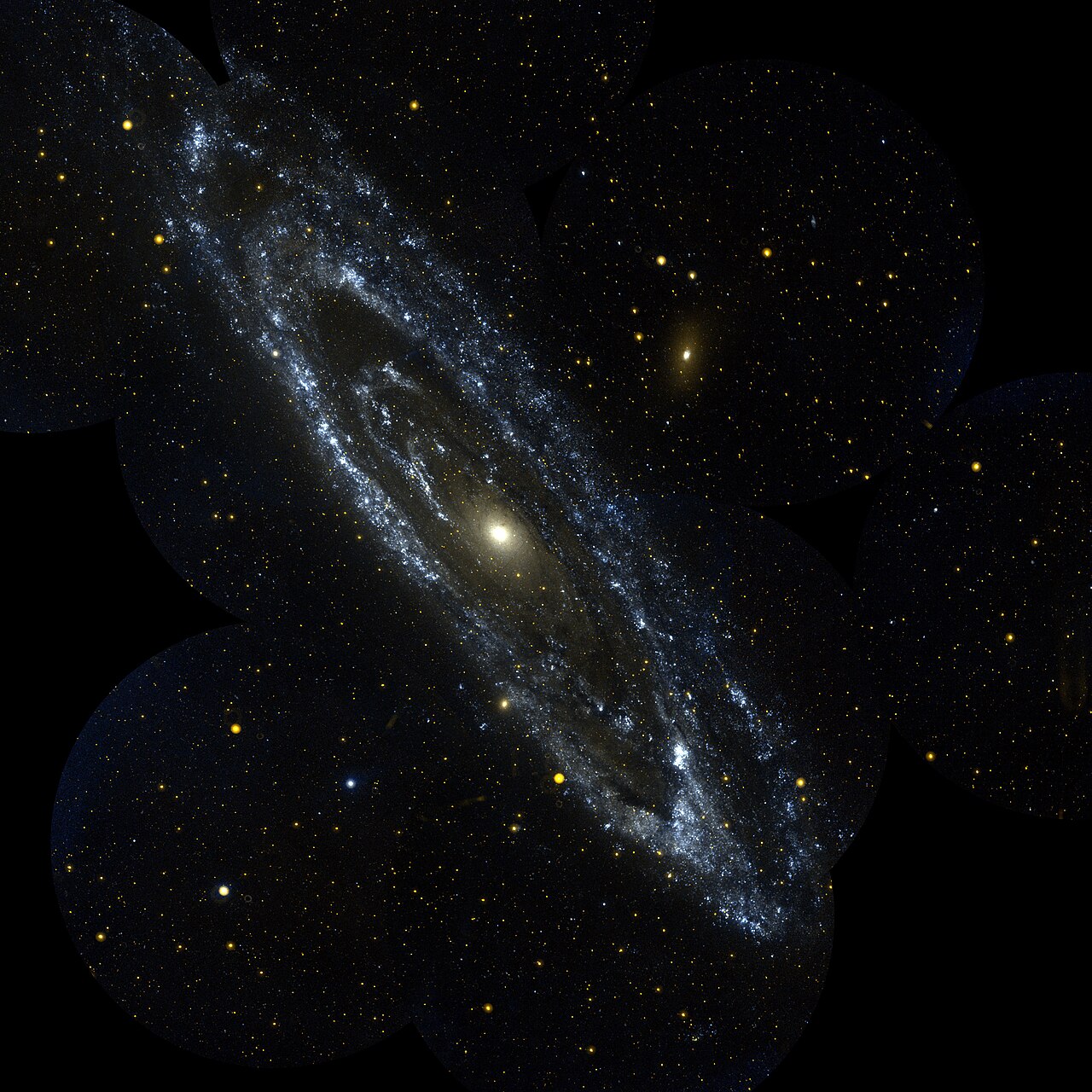
Every smart telescope owner shoots Andromeda in their first month. Most end up with a bright smear in a black frame and quietly wonder what the fuss is about. The problem isn't your scope — it's that M31 breaks the default settings almost everyone uses.
Why M31 is hard for smart scopes
Two reasons. First, it's enormous — over three degrees across, six full Moons side by side. The Seestar S50's native field of view captures only the core region. Second, its dynamic range is brutal: the core is hundreds of times brighter than the outer dust lanes, so exposures that show the arms blow out the middle.
The target card
| Data | |
|---|---|
| Type | Spiral galaxy |
| Constellation | Andromeda |
| Apparent size | ~3° × 1° |
| Best months | September–December (visible from late July, after midnight) |
| Difficulty | Easy to find, hard to do well |
Settings by scope
Seestar S50. Use mosaic/framing mode — this is non-negotiable for M31. A 2×2 mosaic covers the full disk. Filter: none/UV-IR cut (dual-band off — galaxies are broadband light, the LP filter just costs you signal). Subs: 10s or 20s. Integration: 2+ hours minimum across the mosaic; 4 makes it good.
Seestar S30. The wider field is a genuine advantage here — M31 nearly fits in a single frame. Same rules: dual-band off, 2+ hours.
Dwarf 3. Shoot the tele lens with the Astro (UV-IR cut) filter, not the duo-band. Use mosaic mode at 1.5×–2× to get the full disk. The IMX678 sensor's extra resolution shows more dust-lane texture than the Seestars if you feed it enough time.
The one mistake to avoid
Don't judge the target by the live stack at 20 minutes. M31's outer arms are genuinely faint; they emerge with integration time and a proper stretch. If your result looks like a bright egg yolk, the data is probably fine — the arms are hiding in the histogram. Re-process the FITS/TIFF export with a harder stretch (free tools: Siril, GraXpert) and the galaxy appears.
When to shoot it
From mid-northern latitudes M31 clears 30° altitude after midnight in late July, by 10 PM in September, and sits near the zenith on November evenings. Shooting it high in the sky matters more than any setting in the app — at 20° altitude you're imaging through twice the atmosphere.
Quick FAQ
Can the Seestar S50 fit all of Andromeda? Not in a single frame — you need mosaic mode (2×2). The S30 and Dwarf 3 wide framing come much closer.
Dual-band filter on or off for M31? Off. Dual-band filters are for emission nebulae. On a broadband galaxy they throw away most of your light.
How long should I integrate? Two hours is the floor for a result you'll want to share; four or more brings out real dust-lane detail. Smart scopes let you accumulate across multiple nights — use that.